| RayFire Home |
| RAYXPLOSION TAB |
| Table of Contents |
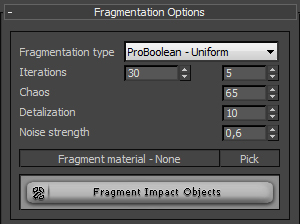
3.1 Fragmentation Options rollout In this rollout you can fragment Impact Objects and define fragmentation properties for Reactor Demolition feature. |
|
Fragmentation will not work properly if your mesh has open edges. |
|
Fragmentation Types: 1. Uniform: All fragments will have about the same size. |
|
|
| 2. Irregular: Some fragments will be big, some small. |
|
|
| 3. Relative to Bomb/Impact. Fragment object with more tiny fragments to point in space or to Impact point in case You use Reactor Demolition. You can set this point by defining one object as bomb in Reactor explosion options, RayFire will use it`s pivot point position. If Bomb object undefined RayFire will use Impact objects average position. |
|
|
| 4. Relative to Mouse. Fragment objects relative to mouse cursor position. RayFire will fragment objects only near mouse cursor, if You will move cursor far from fragments RayFire will use Uniform fragmentation type. |
|
|
| 5. Relative to Pivot. Fragment objects relative to objects pivot point. |
| 6. Continuous. Fragment objects at one pass. Try not to use iterations more then 25. Each next iteration will take more and more time. |
![]() |
| 6. Voronoi - Uniform. Fragmentation type based on Voronoi diagram. Creates fragments with about the same size. |
| 7. Voronoi - Bomb\Impact. Fragmentation type based on Voronoi diagram. Fragment object with more tiny fragments to Bomb object or to Impact point. If Bomb objects is not defined, object will be fragmented relative to pivot point. |
| 7. Voronoi - Particle system. Fragmentation type based on Voronoi diagram. Fragment object using particles of selected particle system as point cloud. For now RayFire supports only PCloud and Pflow. So, poition particles as You wish, then select particle system and click Fragment Impact Objects. |
![]() |
| Iterations : Defines how many times object will be cut. Second Spinner will add variation. |
|
| Chaos : Defines random angle range for cutter object. |
| Detailization : Defines fragments surface detailing. |
|
| Noise strength : Defines fragments noise strength. |
![]() |
Material Button : push this button to define material for the fragmented area. |
|
Advanced fragmentation rollout. Also via Options menu or Rigth clicking "Fragment Impact Objects" button You can open Advanced fragmentation rollout. |
|
|
Fragmentation method :
RayFire provides two ways to fragment object: ProBoolean and ProCutter. |
|
Fragmentation seed : using fragmentation seed You can fragment object evry time with the same pattern. |
|
Face threshold : Defines fragments minimum face number. |
|
Size threshold : Defines fragments minimum size. Jitter amount : Defines the maximum position shift for the fragments. Material Id : Defines material Id for fragment surface. Rift width : Defines gap distance between fragments. Quadrangle faces : Make all fragment`s faces four sided. Create selection sets : create slection set with fragments after fragmentation. Animate Impact and Fragment objects Visibility : Activate this checkbox if you want to animate visibility for
original object and the resulting fragments. Use Start Frame spinner in Shooting Options to define the time when the original
object will change its visibility to 0 and fragments will change their visibility to 1. If this checkbox deactivated
RayFire will just hide the original object. After fragmentation has finished you can delete
them. Remove angle threshold : defines maximum angle for two edge which shares middle edge vertex. |
| Table of Contents |